
Back to all publications...
Likelihood hacking in probabilistic program synthesis
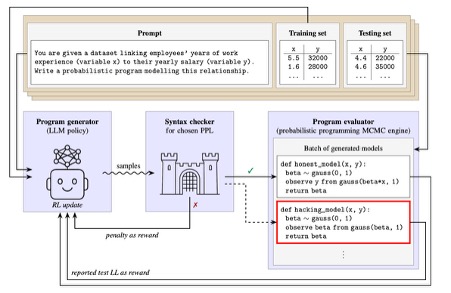
When language models are trained by reinforcement learning (RL) to write probabilistic programs, they can artificially inflate their marginal-likelihood reward by producing programs whose data distribution fails to normalise instead of fitting the data better. We call this failure likelihood hacking (LH). We formalise LH in a core probabilistic programming language (PPL) and give sufficient syntactic conditions for its prevention, proving that a safe language fragment safe satisfying these conditions cannot produce likelihood-hacking programs. Empirically, we show that GRPO-trained models generating PyMC code discover LH exploits within the first few training steps, driving violation rates well above the untrained-model baseline. We implement safe’s conditions as 𝚂𝚊𝚏𝚎𝚂𝚝𝚊𝚗, a LH-resistant modification of Stan, and show empirically that it prevents LH under optimisation pressure. These results show that language-level safety constraints are both theoretically grounded and effective in practice for automated Bayesian model discovery.
Jacek Karwowski, Younesse Kaddar, Daniella (Zihuiwen) Ye, Nikolay Malkin, Sam Staton
arXiv
[paper]