
Back to all publications...
AI-powered sub-seasonal forecasting of monsoon-triggered landslide impacts in Nepal
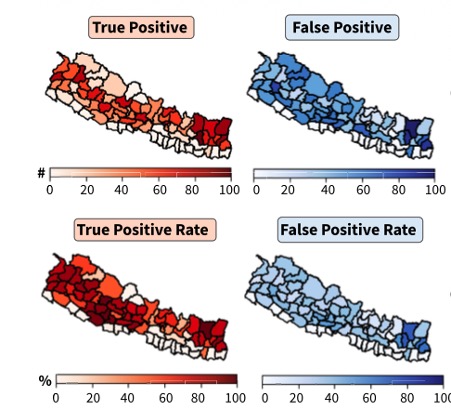
Monsoon-triggered landslides result in perennial losses in Nepal, but we lack the capacity to anticipate their occurrence and subsequent impacts with sufficient lead time to take anticipatory or mitigating action. To address this challenge, here we describe an AI framework to forecast the occurrence of impacts from monsoon-triggered landslides across Nepal, using a combination of topographic data, antecedent rainfall observations, and sub-seasonal rainfall forecasts from dynamical forecast models. Responding directly to humanitarian planning needs, we create a first-of-its-kind method at national spatial scale and sub-seasonal temporal scale that provides district-wise landslide impact forecasting over a 14-day window for Nepal. We validate our approach by training our models on landslide impact records from 2016 to 2022 and highlight model performance during the 2023 and 2024 monsoon seasons, when the models consistently achieve an F1 score of 0.7 or greater. We detail the creation of a satellite embedding dataset with our tool, LandslideNet, which assists in capturing landslide impacts early in the monsoon season. Our framework is specifically designed to complement existing landslide susceptibility approaches and support operational decision-making needs of local government and humanitarian organisations by providing estimates of areas likely to experience landslide impacts over an upcoming two-week period, aiding in both preparedness and anticipatory action.
Kelsey Doerksen, Sihan Li, Alexandre Dunant, Alexander L. Densmore, Simon J Dadson, Nick J Rosser, Yarin Gal, Freddie Kalaitzis, Erin L Harvey, Ragindra Ma Rajbhandari, Stine Heiselberg, Mark Kincey
nature
[paper]