
Back to all members...
Gabriel Jones
Associate Member (Faculty), started 2020

Gabriel is the PI of the Oxford Digital Health Labs group at Nuffield Department of Women’s and Reproductive Health (NDWRH), Director of AI and Big Data Analytics at the Oxford Centre for Global Epilepsy, Co-Director and Oxford Martin Senior Research Fellow at the Nuffield Department of Clinical Neuroscience, and Clinical Research Fellow at the Royal Women’s Hospital in Melbourne, Australia. His research is centered on the practical development and application of machine learning in medicine, with a particular emphasis on global health. He is also an OATML alumni. He received his PhD supervised by Manu Vatish and Chris Redman, co-supervised by Yarin Gal. He obtained his Bachelors and Honours degrees from the University of Melbourne before completing a Doctor of Medicine (MD).
Publications while at OATML • News items mentioning Gabriel Jones • Reproducibility and Code • Blog Posts
Publications while at OATML:
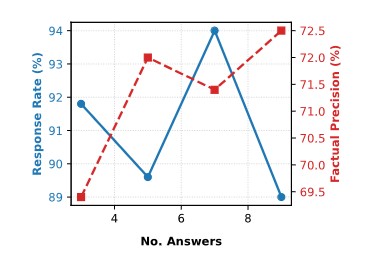
Building Reliable Long-Form Generation via Hallucination Rejection Sampling
Large language models (LLMs) have achieved remarkable progress in open-ended text generation, yet they remain prone to hallucinating incorrect or unsupported content, which undermines their reliability. This issue is exacerbated in long-form generation due to hallucination snowballing, a phenomenon where early errors propagate and compound into subsequent outputs. To address this challenge, we propose a novel inference-time hallucination mitigation framework, named Segment-wise HAllucination Rejection Sampling (SHARS), which uses an arbitrary hallucination detector to identify and reject hallucinated segments during generation and resample until faithful content is produced. By retaining only confident information and building subsequent generations upon it, the framework mitigates hallucination accumulation and enhances factual consistency. To instantiate this framework, we adopt semantic uncertainty as the detector and introduce several vital modifications to address its limitati... [full abstract]
Lin Li, Georgia Channing, Suhaas Bhat, Gabriel Jones, Yarin Gal
ICML 2026
[paper]
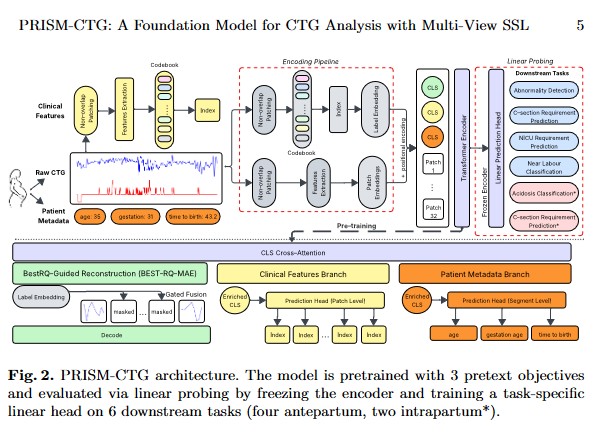
PRISM-CTG: A Foundation Model for Cardiotocography Analysis with Multi-View SSL
Supervised deep learning models for automated CTG analysis are typically constrained by narrowly curated labelled datasets and limited patient cohorts, leaving substantial volumes of physiologically informative clinical recordings untapped. To address this limitation, we propose Physiology-aware Representation Learning via Integrated Self-supervision and Metadata for CTG (PRISM-CTG), a clinically grounded self-supervised foundation model (FM) for CTG that leverages large-scale unlabelled recordings to learn transferable domain-level representations. PRISM-CTG is pretrained using a multi-view self-supervised framework that jointly optimises 3 complementary pretext objectives: random-projected guided masked signal reconstruction, clinical variable prediction, and feature classification. Each objective is associated with a dedicated task-specific token, enabling specialised representation learning, while controlled cross-attention facilitates information exchange across clinical conte... [full abstract]
Sheng Wong, Ravi Shankar, Beth Albert, Hao Fei, Lin Li, Imane Ben M'Barek, Manu Vatish, Gabriel Jones
ECML-PKDD, 2026
[paper]
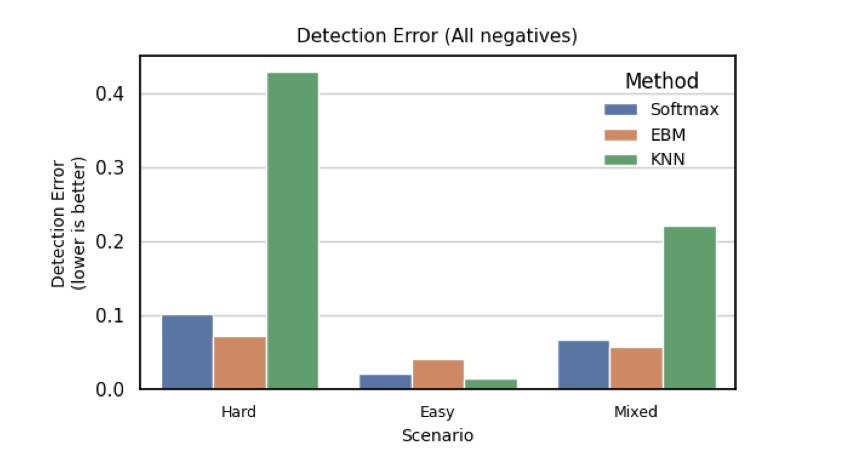
Energy Landscapes Enable Reliable Abstention in Retrieval-Augmented Large Language Models for Healthcare
Reliable abstention is critical for retrieval-augmented generation (RAG) systems, particularly in safety-critical domains such as women's health, where incorrect answers can lead to harm. We present an energy-based model (EBM) that learns a smooth energy landscape over a dense semantic corpus of 2.6M guideline-derived questions, enabling the system to decide when to generate or abstain. We benchmark the EBM against a calibrated softmax baseline and a k-nearest neighbour (kNN) density heuristic across both easy and hard abstention splits, where hard cases are semantically challenging near-distribution queries. The EBM achieves superior abstention performance abstention on semantically hard cases, reaching AUROC 0.961 versus 0.950 for softmax, while also reducing FPR@95 (0.235 vs 0.331). On easy negatives, performance is comparable across methods, but the EBM's advantage becomes most pronounced in safety-critical hard distributions. A comprehensive ablation with controlled negative s... [full abstract]
Ravi Shankar, Sheng Wong, Lin Li, Magdalena Bachmann, Alex Silverthorne, Beth Albert, Gabriel Jones
NeurIPS Workshop GenAI4Health, 2025
[paper]

Reducing Large Language Model Safety Risks in Women's Health using Semantic Entropy
Large language models (LLMs) hold substantial promise for clinical decision support. However, their widespread adoption in medicine, particularly in healthcare, is hindered by their propensity to generate false or misleading outputs, known as hallucinations. In high-stakes domains such as women's health (obstetrics & gynaecology), where errors in clinical reasoning can have profound consequences for maternal and neonatal outcomes, ensuring the reliability of AI-generated responses is critical. Traditional methods for quantifying uncertainty, such as perplexity, fail to capture meaning-level inconsistencies that lead to misinformation. Here, we evaluate semantic entropy (SE), a novel uncertainty metric that assesses meaning-level variation, to detect hallucinations in AI-generated medical content. Using a clinically validated dataset derived from UK RCOG MRCOG examinations, we compared SE with perplexity in identifying uncertain responses. SE demonstrated superior performance, achie... [full abstract]
Jahan C. Penny-Dimri, Magdalena Bachmann, William R. Cooke, Sam Mathewlynn, Samual Dockree, John Tolladay, Jannik Kossen, Lin Li, Yarin Gal, Gabriel Jones
The Lancet Obstetrics, Gynaecology, & Women’s Health, 2025
[paper]
Blog Posts

OATML at ICML 2026
OATML group members and collaborators are proud to present 5 papers at ICML 2026. …
Full post...Yarin Gal, Sergio Calvo Ordoñez, Sören Mindermann, Panagiotis Tigas, Lin Li, Suhaas Bhat, Gabriel Jones, 08 Jul 2026