
Back to all members...
Luckeciano Carvalho Melo
PhD, started 2023

Luckeciano is a DPhil student in the OATML group, supervised by Yarin Gal and Alessandro Abate. His research interests lie in designing agents that learn behaviors through interactions in an efficient, generalist, safe,
and adaptive way. He believes that such agents emerge from three main pillars: semantically rich representations of entities
in the world; self-supervised World Models with inductive biases for memory and counterfactual reasoning; and fast policy
adaptation mechanisms for out-of-distribution generalization.
Previously, he worked as an Applied Scientist at Microsoft, working with multi-modal representation learning and large language models for web data semantic understanding. He also led the RL Research group at the Center of Excellence in AI in Brazil, working with real-world RL applications in scalable digital platforms with industry partners.
Publications while at OATML • News items mentioning Luckeciano Carvalho Melo • Reproducibility and Code • Blog Posts
Publications while at OATML:
Partial Reasoning in Language Models: Search and Refinement Guided by Uncertainty
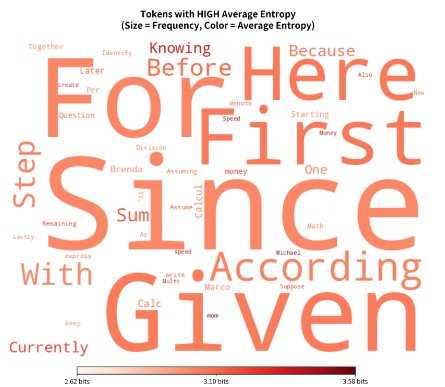
The use of Large Language Models (LLMs) for reasoning and planning tasks has drawn increasing attention in Artificial Intelligence research. Despite their remarkable progress, these models still exhibit limitations in multi-step inference scenarios, particularly in mathematical and logical reasoning. We introduce PREGU (Partial Reasoning Guided by Uncertainty). PREGU monitors the entropy of the output distribution during autoregressive generation and halts the process whenever entropy exceeds a defined threshold, signaling uncertainty. From that point, a localized search is performed in the latent space to refine the partial reasoning and select the most coherent answer, using the Soft Reasoning method. Experiments conducted with LLaMA-3-8B, Mistral-7B, and Qwen2-7B across four reasoning benchmarks (GSM8K, GSM-Hard, SVAMP, and StrategyQA) showed performance greater than or similar to Soft Reasoning, indicating that entropy can serve as an effective signal to trigger selective refin... [full abstract]
Murilo da Luz, Bruno Brandão, Luana Martins, Gustavo Oliveira, Bryan de Oliveira, Luckeciano Carvalho Melo, Telma Soares
arXiv
[paper]
Iterative Deployment Improves Planning Skills in LLMs
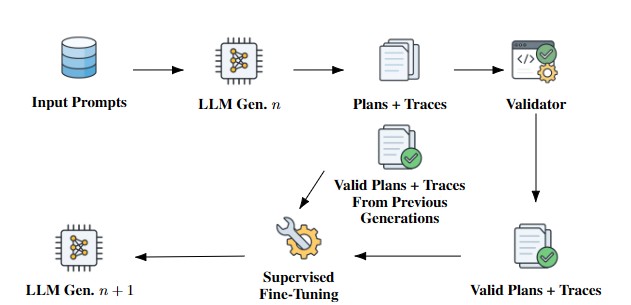
We show that iterative deployment of large language models (LLMs), each fine-tuned on data carefully curated by users from the previous models' deployment, can significantly change the properties of the resultant models. By testing this mechanism on various planning domains, we observe substantial improvements in planning skills, with later models displaying emergent generalization by discovering much longer plans than the initial models. We then provide theoretical analysis showing that iterative deployment effectively implements reinforcement learning (RL) training in the outer-loop (i.e. not as part of intentional model training), with an implicit reward function. The connection to RL has two important implications: first, for the field of AI safety, as the reward function entailed by repeated deployment is not defined explicitly, and could have unexpected implications to the properties of future model deployments. Second, the mechanism highlighted here can be viewed as an alter... [full abstract]
Wanru Zhao, Augusto B Corrêa, Yoav Gelberg, Luckeciano Carvalho Melo, Ilia Shumailov, André G. Pereira, Yarin Gal
arXiv
[paper]
Learning Without Critics? Revisiting GRPO in Classical Reinforcement Learning Environments
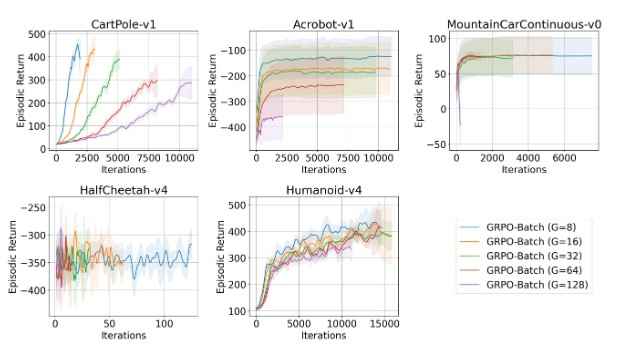
Group Relative Policy Optimization (GRPO) has emerged as a scalable alternative to Proximal Policy Optimization (PPO) by eliminating the learned critic and instead estimating advantages through group-relative comparisons of trajectories. This simplification raises fundamental questions about the necessity of learned baselines in policy-gradient methods. We present the first systematic study of GRPO in classical single-task reinforcement learning environments, spanning discrete and continuous control tasks. Through controlled ablations isolating baselines, discounting, and group sampling, we reveal three key findings: (1) learned critics remain essential for long-horizon tasks: all critic-free baselines underperform PPO except in short-horizon environments like CartPole where episodic returns can be effective; (2) GRPO benefits from high discount factors (gamma = 0.99) except in HalfCheetah, where lack of early termination favors moderate discounting (gamma = 0.9); (3) smaller group... [full abstract]
Bryan L. M. de Oliveira, Felipe V. Frujeri, Marcos P. C. M. Queiroz, Luana G. B. Martins, Telma W. de L. Soares, Luckeciano Carvalho Melo
arXiv
[paper]
Stabilizing Policy Gradients for Sample-Efficient Reinforcement Learning in LLM Reasoning
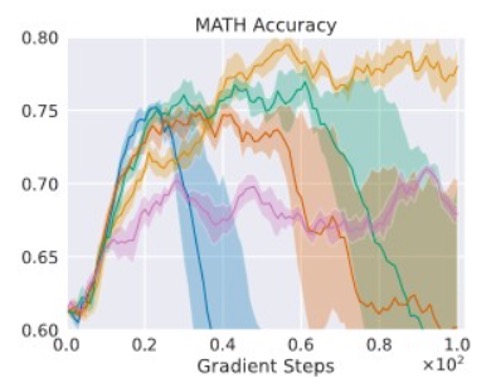
Reinforcement Learning, particularly through policy gradient methods, has played a central role in enabling reasoning capabilities of Large Language Models. However, the optimization stability of policy gradients in this setting remains understudied. As a result, existing implementations often resort to conservative hyperparameter choices to ensure stability, which requires more training samples and increases computational costs. Hence, developing models for reliably tracking the underlying optimization dynamics and leveraging them into training enables more sample-efficient regimes and further unleashes scalable post-training. We address this gap by formalizing the stochastic optimization problem of policy gradients with explicit consideration of second-order geometry. We propose a tractable computational framework that tracks and leverages curvature information during policy updates. We further employ this framework to design interventions in the optimization process through data... [full abstract]
Luckeciano Carvalho Melo, Alessandro Abate, Yarin Gal
ICLR 2026
[paper]
Uncertainty-Aware Step-wise Verification with Generative Reward Models
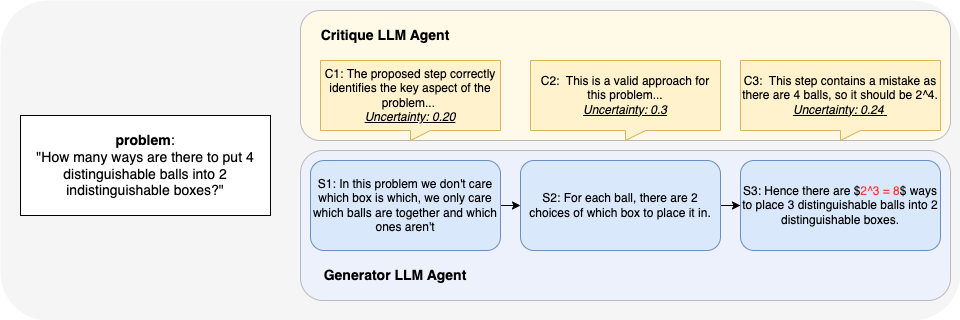
Complex multi-step reasoning tasks, such as solving mathematical problems, remain challenging for large language models (LLMs). While outcome supervision is commonly used, process supervision via process reward models (PRMs) provides intermediate rewards to verify step-wise correctness in solution traces. However, as proxies for human judgement, PRMs suffer from reliability issues, including susceptibility to reward hacking. In this work, we propose leveraging uncertainty quantification (UQ) to enhance the reliability of step-wise verification with generative reward models for mathematical reasoning tasks. We introduce CoT Entropy, a novel UQ method that outperforms existing approaches in quantifying a PRM's uncertainty in step-wise verification. Our results demonstrate that incorporating uncertainty estimates improves the robustness of judge-LM PRMs, leading to more reliable verification.
Daniella (Zihuiwen) Ye, Luckeciano Carvalho Melo, Younesse Kaddar, Phil Blunsom, Sam Staton, Yarin Gal
arXiv
[paper]
InfoQuest: Evaluating Multi-Turn Dialogue Agents for Open-Ended Conversations with Hidden Context
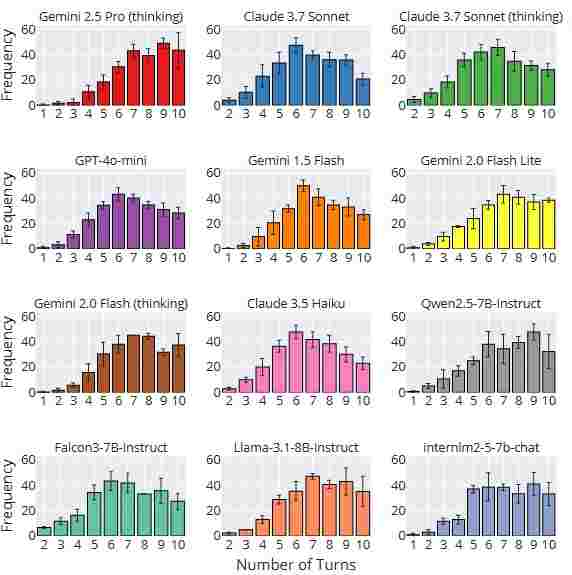
Large language models excel at following explicit instructions, but they often struggle with ambiguous or incomplete user requests, defaulting to verbose, generic responses instead of seeking clarification. We introduce InfoQuest, a multi-turn chat benchmark designed to evaluate how dialogue agents handle hidden context in open-ended user requests. This benchmark presents intentionally ambiguous scenarios that require models to engage in information-seeking dialogue by asking clarifying questions before providing appropriate responses. Our evaluation of both open and closed models reveals that, while proprietary models generally perform better, all current assistants struggle to gather critical information effectively. They often require multiple turns to infer user intent and frequently default to generic responses without proper clarification. We provide a systematic methodology for generating diverse scenarios and evaluating models' information-seeking capabilities, which can be... [full abstract]
Bryan L. M. de Oliveira, Luana G. B. Martins, Bruno Brandão, Luckeciano Carvalho Melo
arXiv
[paper]
Deep Bayesian Active Learning for Preference Modeling in Large Language Models
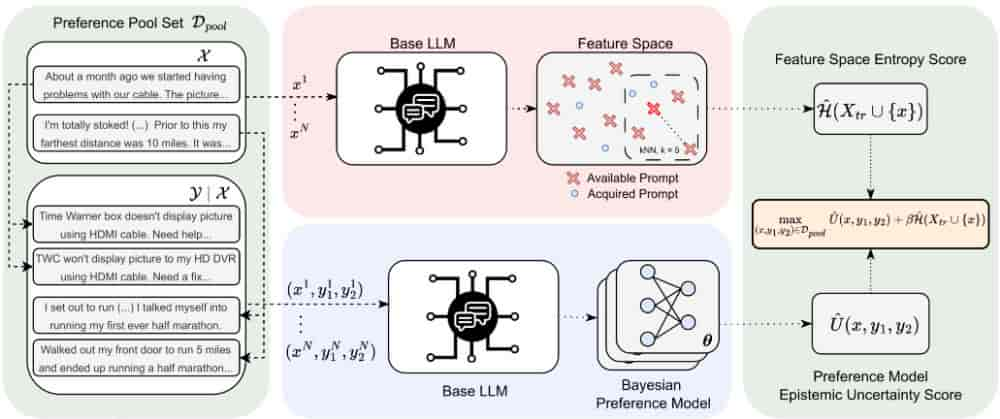
Leveraging human preferences for steering the behavior of Large Language Models (LLMs) has demonstrated notable success in recent years. Nonetheless, data selection and labeling are still a bottleneck for these systems, particularly at large scale. Hence, selecting the most informative points for acquiring human feedback may considerably reduce the cost of preference labeling and unleash the further development of LLMs. Bayesian Active Learning provides a principled framework for addressing this challenge and has demonstrated remarkable success in diverse settings. However, previous attempts to employ it for Preference Modeling did not meet such expectations. In this work, we identify that naive epistemic uncertainty estimation leads to the acquisition of redundant samples. We address this by proposing the Bayesian Active Learner for Preference Modeling (BAL-PM), a novel stochastic acquisition policy that not only targets points of high epistemic uncertainty according to the prefer... [full abstract]
Luckeciano Carvalho Melo, Panagiotis Tigas, Alessandro Abate, Yarin Gal
38th Conference on Neural Information Processing Systems (NeurIPS 2024)
[paper]
Temporal-Difference Variational Continual Learning
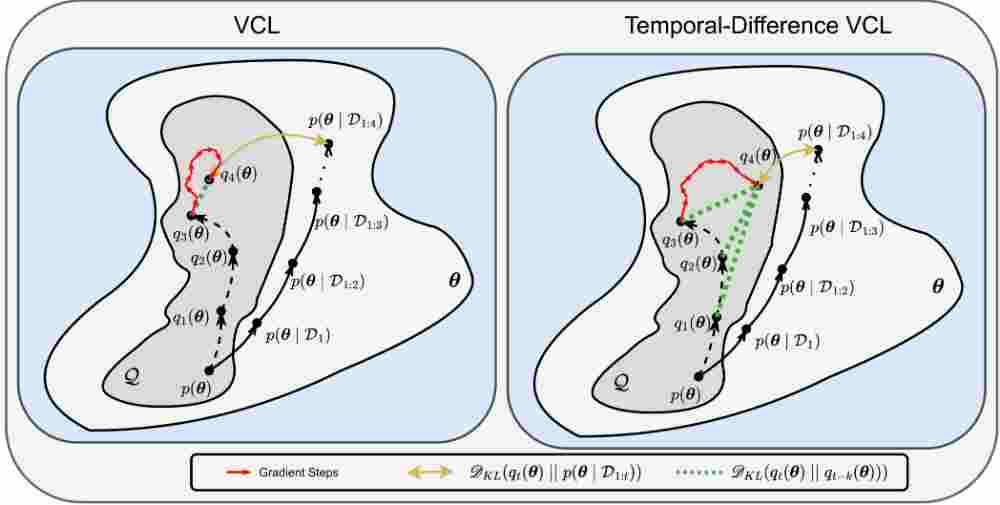
A crucial capability of Machine Learning models in real-world applications is the ability to continuously learn new tasks. This adaptability allows them to respond to potentially inevitable shifts in the data-generating distribution over time. However, in Continual Learning (CL) settings, models often struggle to balance learning new tasks (plasticity) with retaining previous knowledge (memory stability). Consequently, they are susceptible to Catastrophic Forgetting, which degrades performance and undermines the reliability of deployed systems. Variational Continual Learning methods tackle this challenge by employing a learning objective that recursively updates the posterior distribution and enforces it to stay close to the latest posterior estimate. Nonetheless, we argue that these methods may be ineffective due to compounding approximation errors over successive recursions. To mitigate this, we propose new learning objectives that integrate the regularization effects of multiple... [full abstract]
Luckeciano Carvalho Melo, Alessandro Abate, Yarin Gal
NeurIPS 2025
[paper]
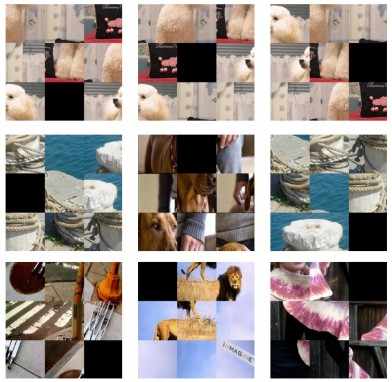
Sliding Puzzles Gym: A Scalable Benchmark for State Representation in Visual Reinforcement Learning
Effective visual representation learning is crucial for reinforcement learning (RL) agents to extract task-relevant information from raw sensory inputs and generalize across diverse environments. However, existing RL benchmarks lack the ability to systematically evaluate representation learning capabilities in isolation from other learning challenges. To address this gap, we introduce the Sliding Puzzles Gym (SPGym), a novel benchmark that transforms the classic 8-tile puzzle into a visual RL task with images drawn from arbitrarily large datasets. SPGym's key innovation lies in its ability to precisely control representation learning complexity through adjustable grid sizes and image pools, while maintaining fixed environment dynamics, observation, and action spaces. This design enables researchers to isolate and scale the visual representation challenge independently of other learning components. Through extensive experiments with model-free and model-based RL algorithms, we uncov... [full abstract]
Bryan L.M de Oliveira, Luana G. B. Martins, Bruno Brandão, Murilo L. da Luz, Telma W. de L. Soares, Luckeciano Carvalho Melo
Published at ICML 2025
[paper]
Blog Posts

OATML conference papers at NeurIPS 2025
OATML group members and collaborators are proud to present 8 papers at NeurIPS 2025. …
Full post...Yarin Gal, Lukas Aichberger, Jannik Kossen, Luckeciano Carvalho Melo, Gunshi Gupta, Muhammed Razzak, Freddie Bickford Smith, Xander Davies, Hazel Kim, 19 Sep 2025