
Back to all members...
Yoav Gelberg
PhD, started 2024
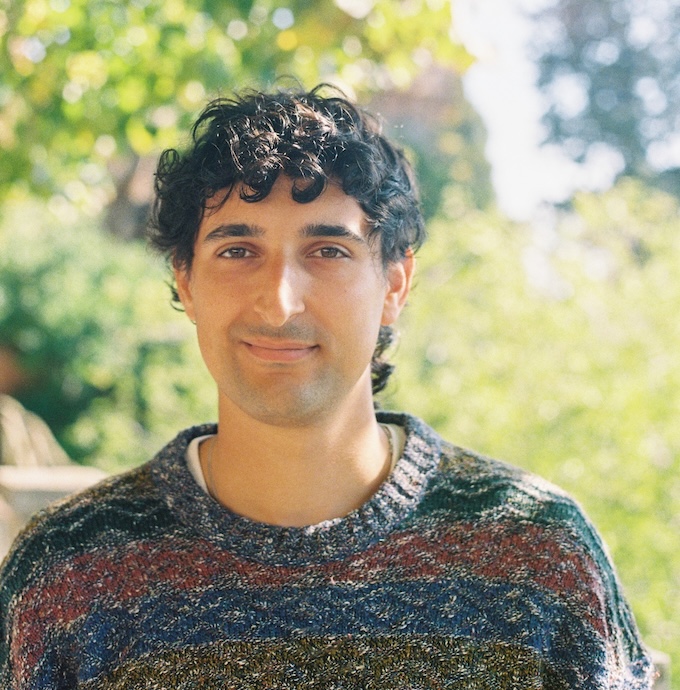
Yoav is a PhD student at the University of Oxford, co-advised by Yarin Gal, Michael Bronstein, and Haggai Maron. His research focuses on the symmetry and structure of neural network parameter spaces, with the goal of performing meta-learning tasks over model weights. He holds an undergraduate degree in mathematics from the Technion, where he was a Rothschild scholar. Before joining Oxford, Yoav conducted research on expander graphs at the Weizmann Institute, developed fair learning algorithms at Fairgen, and taught math and programming at the ARDC. His PhD is funded by the EPSRC through the AIMS CDT program.
Publications while at OATML • News items mentioning Yoav Gelberg • Reproducibility and Code • Blog Posts
Publications while at OATML:
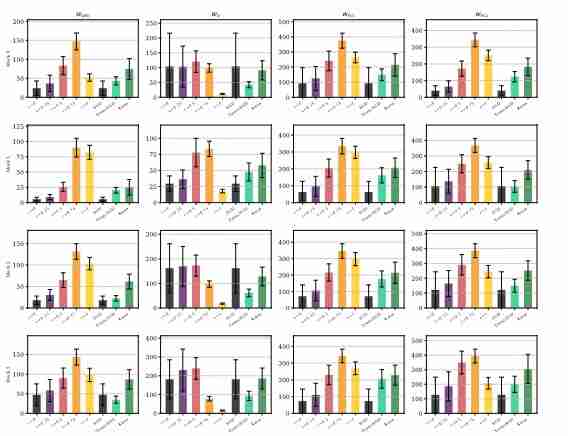
Muon is Not That Special: Random or Inverted Spectra Work Just as Well
The recent empirical success of the Muon optimizer has renewed interest in non-Euclidean optimization, typically justified by similarities with second-order methods, and linear minimization oracle (LMO) theory. In this paper, we challenge this geometric narrative through three contributions, demonstrating that precise geometric structure is not the key factor affecting optimization performance. First, we introduce Freon, a family of optimizers based on Schatten (quasi-)norms, powered by a novel, provably optimal QDWH-based iterative approximation. Freon naturally interpolates between SGD and Muon, while smoothly extrapolating into the quasi-norm regime. Empirically, the best-performing Schatten parameters for GPT-2 lie strictly within the quasi-norm regime, and thus cannot be represented by any unitarily invariant LMO. Second, noting that Freon performs well across a wide range of exponents, we introduce Kaon, an absurd optimizer that replaces singular values with random noise. Des... [full abstract]
Zakhar Shumaylov, Nathaël Da Costa, Peter Zaika, Bálint Mucsányi, Alex Massucco, Yoav Gelberg, Carola-Bibiane Schönlieb, Yarin Gal, Philipp Hennig
arXiv
[paper]
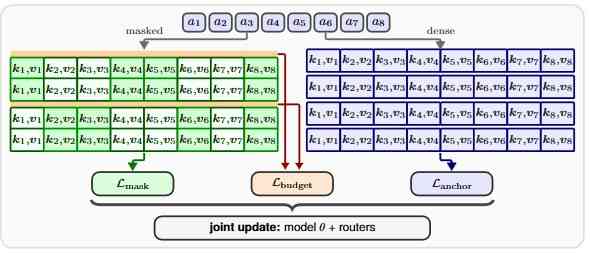
Training Transformers for KV Cache Compressibility
Long-context language modeling is increasingly constrained by the Key-Value (KV) cache, whose memory and decode-time access costs scale linearly with the prefix length. This bottleneck has motivated a range of context-compression methods, from token-level summarization to recent optimization-based KV compression methods. These post-hoc methods operate on the KV cache of a fixed pretrained model, so their effectiveness is fundamentally limited by how well the model's internal representations can be compressed. In this work, we formalize the notion of KV compressibility and show that it is a property of the learned representations, rather than of the context alone. We prove that almost any sequence-to-vector function admits both highly compressible and inherently non-compressible transformer implementations, highlighting the need to guide transformers toward compressible representations during training. Motivated by this, we propose KV-Compression Aware Training (KV-CAT), a continued... [full abstract]
Yoav Gelberg, Yam Eitan, Michael Bronstein, Yarin Gal, Haggai Maron
arXiv
[paper]
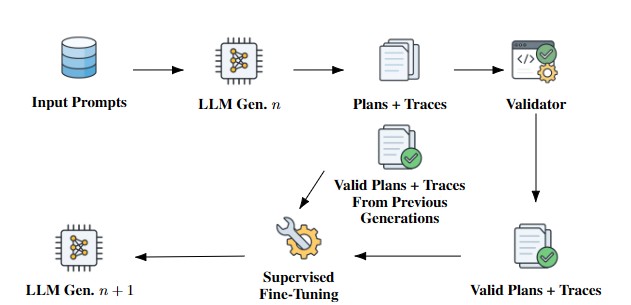
Iterative Deployment Improves Planning Skills in LLMs
We show that iterative deployment of large language models (LLMs), each fine-tuned on data carefully curated by users from the previous models' deployment, can significantly change the properties of the resultant models. By testing this mechanism on various planning domains, we observe substantial improvements in planning skills, with later models displaying emergent generalization by discovering much longer plans than the initial models. We then provide theoretical analysis showing that iterative deployment effectively implements reinforcement learning (RL) training in the outer-loop (i.e. not as part of intentional model training), with an implicit reward function. The connection to RL has two important implications: first, for the field of AI safety, as the reward function entailed by repeated deployment is not defined explicitly, and could have unexpected implications to the properties of future model deployments. Second, the mechanism highlighted here can be viewed as an alter... [full abstract]
Wanru Zhao, Augusto B Corrêa, Yoav Gelberg, Luckeciano Carvalho Melo, Ilia Shumailov, André G. Pereira, Yarin Gal
arXiv
[paper]
Variational Inference Failures Under Model Symmetries: Permutation Invariant Posteriors for Bayesian Neural Networks
Weight space symmetries in neural network architectures, such as permutation symmetries in MLPs, give rise to Bayesian neural network (BNN) posteriors with many equivalent modes. This multimodality poses a challenge for variational inference (VI) techniques, which typically rely on approximating the posterior with a unimodal distribution. In this work, we investigate the impact of weight space permutation symmetries on VI. We demonstrate, both theoretically and empirically, that these symmetries lead to biases in the approximate posterior, which degrade predictive performance and posterior fit if not explicitly accounted for. To mitigate this behavior, we leverage the symmetric structure of the posterior and devise a symmetrization mechanism for constructing permutation invariant variational posteriors. We show that the symmetrized distribution has a strictly better fit to the true posterior, and that it can be trained using the original ELBO objective with a modified KL regulariza... [full abstract]
Yoav Gelberg, Tycho F.A. van der Ouderaa, Mark van der Wilk, Yarin Gal
ICML Workshop on Geometry-grounded Representation Learning and Generative Modeling (GRaM), 2024
[paper]
News items mentioning Yoav Gelberg:

ICML 2024 GRaM workshop 'Best Paper' awarded
29 Jul 2024
A paper by Yoav Gelberg, Tycho F.A. van der Ouderaa, Mark van der Wilk and Yarin Gal received the top award in the Proceedings track of the ICML Workshop on Geometry-grounded Representation Learning and Generative Modeling (GRaM). You can read the paper on variational inference failures under model symmetries here.
